
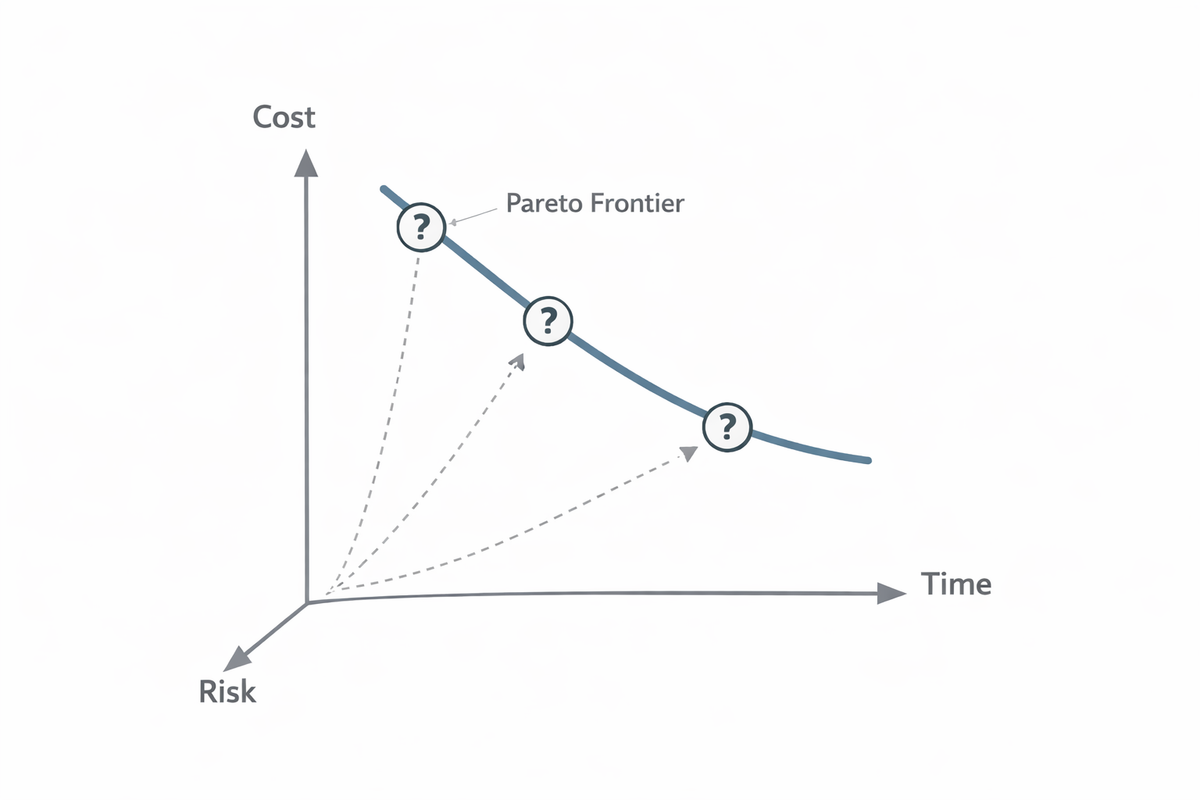
Stochastic & Multi-Objective Optimization Models
Multi-stage and multi-objective optimization models for complex resource allocation and scheduling under uncertainty.
Applications include healthcare scheduling, project team formation, and resource allocation in dynamic environments.
Approach
This work develops:
- Multi-stage stochastic programming formulations
- Multi-objective optimization models
- Simulation–optimization frameworks
- Workforce and team formation decision models
The emphasis is on modeling complexity faithfully while maintaining computational tractability.
Impact
These models demonstrate how structured optimization can support decision-making in complex service and project-based systems.
They extend optimization theory into practical, multi-objective environments with real uncertainty.
Selected Publications
- Rahmanniyay, Yu & Seif (2019), Computers & Industrial Engineering
- Dehghanimohammadabadi et al. (2022), SIMULATION
Publications
Multi-Objective Patient Appointment Scheduling Framework (MO-PASS): a data-table input simulation–optimization approach
This paper introduces a Multi-Objective Patient Appointment Scheduling (MO-PASS) framework integrating optimization, data exchange, and discrete-event simulatio…
A Multidisciplinary Team Formation Problem for Projects in the Aerospace Industry
This study applies linear programming to determine the optimal structure of a multidisciplinary team in aerospace projects. The model assigns team members with …
A multi-objective multi-stage stochastic model for project team formation under uncertainty in time requirements
Team formation is one of the key stages in project management. The cost associated with the individuals who form a team and the quality of the tasks completed b…