
Reliability Engineering and Predictive Maintenance
Reliability modeling and predictive maintenance frameworks that integrate prognostics, statistical analysis, and machine learning into operational decision systems.
Problem Space
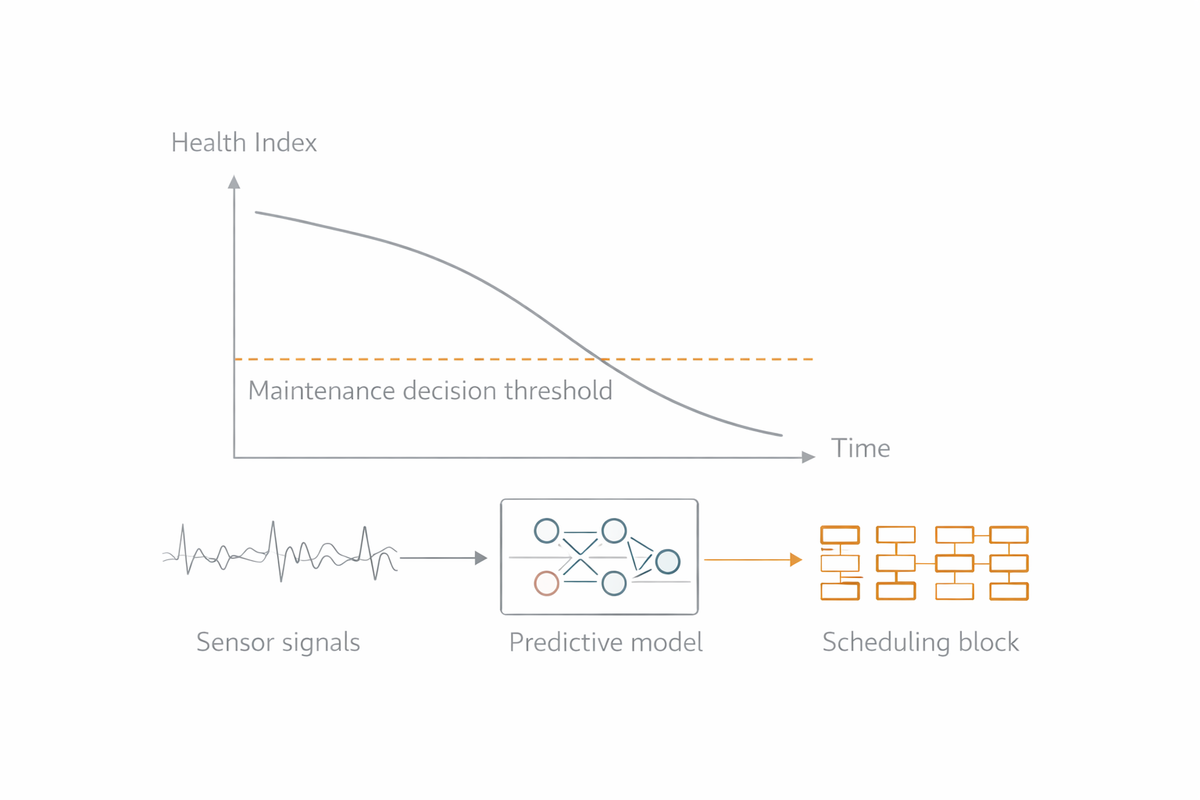
Modern industrial and aerospace systems generate increasing volumes of operational data, yet maintenance decisions often remain reactive or interval-based.
The challenge is not simply predicting failure.
It is embedding reliability intelligence into operational planning and decision systems.
Predictive maintenance becomes powerful only when it influences scheduling, resource allocation, and availability optimization.
Research & Contributions
This body of work focuses on:
- Reliability estimation using statistical and machine learning methods
- Simulation-based evaluation of condition-based maintenance policies
- Integration of predictive indicators into operational models
- Quantifying tradeoffs between preventive and predictive strategies
Selected contributions include:
- Hybrid machine learning models for reliability estimation
- Simulation–ANOVA analysis of condition-based maintenance alternatives
- Statistical learning approaches for reducing false alarms in control systems
- Prognostic integration into Flight & Maintenance Planning frameworks
Rather than treating predictive maintenance as a standalone analytics problem, this work emphasizes decision impact — how reliability signals reshape system-level outcomes.
Forward Direction
This area is evolving toward:
- Prognostic-enabled optimization models
- Health-aware scheduling systems
- Integration of degradation modeling with stochastic decision frameworks
- Reliability-driven fleet and asset management automation
The long-term objective is the development of decision architectures where reliability models are not advisory tools, but embedded components of optimization-driven systems.
Publications
An integrated simulation-analysis of variance methodology for effective analysis of CBM alternatives
This study introduces an integrated simulation-analysis of variance methodology to analyse the cost-effectiveness of condition-based maintenance (CBM) alternati…
An integrated support vector regression–imperialist competitive algorithm for reliability estimation of a shearing machine
This study develops a support vector regression (SVR) model integrated with an imperialist competitive algorithm for reliability estimation. The model is valida…