
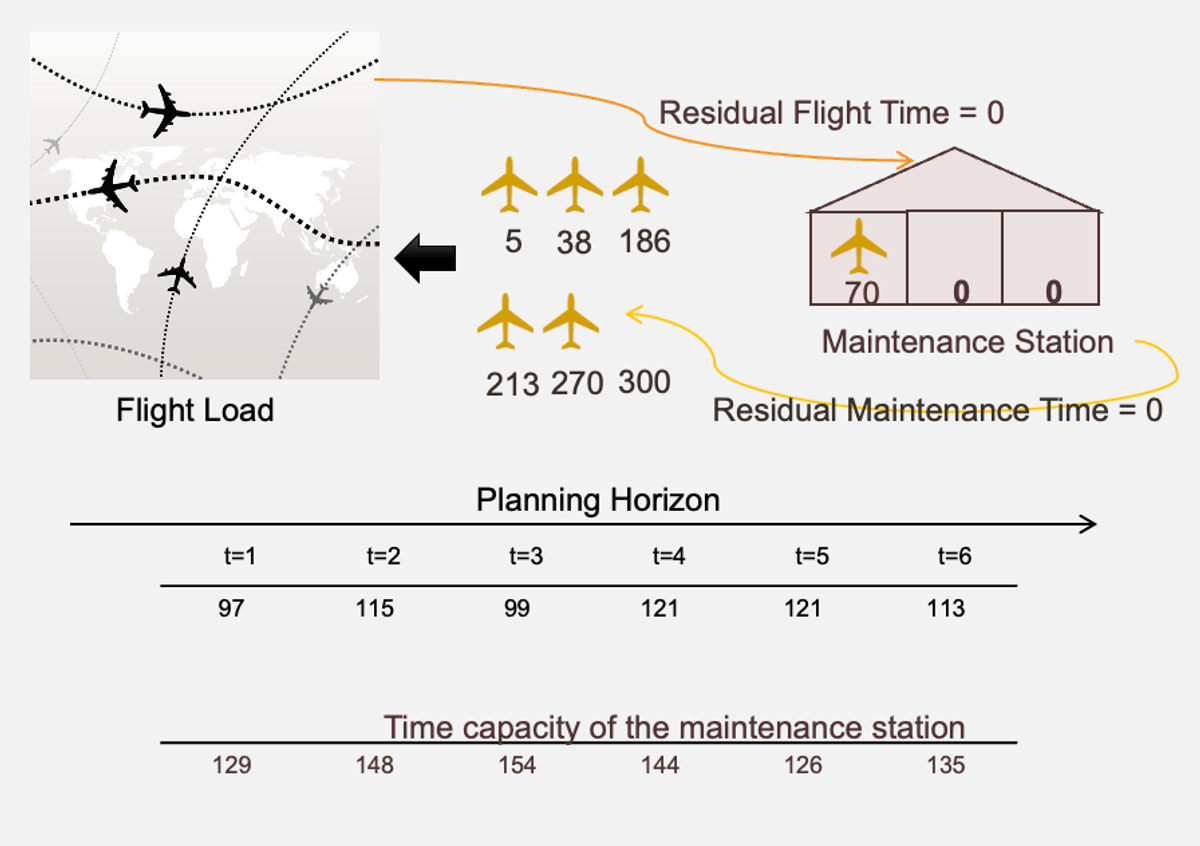
Flight & Maintenance Planning (FMP)
Optimization-driven flight and maintenance planning models for aircraft fleets, integrating availability, preventive maintenance, and emerging prognostic health indicators.
Problem Space
Aircraft fleet management requires balancing two fundamentally conflicting objectives:
- Maximizing operational readiness (flight availability)
- Performing preventive maintenance at the right time
Traditional flight scheduling and maintenance routing treat these as loosely connected problems. In reality, they form a tightly coupled system where availability, inspection intervals, station capacity, and operational demand must be optimized simultaneously.
The Flight & Maintenance Planning (FMP) problem addresses this challenge directly.
Core Contribution
My 2018 work extends the classical Flight & Maintenance Planning formulation into a generalized Operations & Maintenance Planning (OMP) model.
Key extensions include:
- Multiple preventive maintenance activities with different intervals
- Multiple maintenance stations with capacity constraints
- Multi-purpose aircraft assigned to multiple mission types
- Usage-based residual flight time modeling
- Exact solution algorithm scalable to large fleet sizes
The objective maximizes cumulative operational availability while satisfying maintenance, crew, and station constraints.
Unlike heuristic approaches, this model provides an exact optimization framework capable of handling realistic fleet sizes and operational complexity.
Algorithmic Insight
A key theoretical result:
Maximizing fleet availability is equivalent to maximizing the flow of aircraft into and out of maintenance stations.
This led to:
- A redesigned upper-bound algorithm
- A combination-based feasibility screening approach
- Significant computational improvements over commercial solvers for realistic fleet sizes
The methodology scales to large fleet sizes and supports re-optimization under updated operational conditions.
Emerging Direction: Prognostic-Integrated FMP
Recent graduate work extends this framework by integrating structural health indicators directly into FMP scheduling.
This introduces:
- Fatigue-based cumulative damage modeling
- Health-driven residual useful life estimation
- Feedback loop between schedule and structural degradation
- Integration of prognostics into maintenance decision variables
Rather than scheduling maintenance solely by interval thresholds, the system dynamically updates maintenance timing based on predicted component health.
This bridges optimization modeling and predictive maintenance.
Why This Matters
Modern fleets — commercial or military — operate under:
- Increasing maintenance costs
- Availability pressures
- Predictive maintenance data streams
- Complex mission requirements
Flight & Maintenance Planning becomes a decision automation problem, not a static scheduling problem.
This research direction positions optimization as the backbone for:
- Fleet readiness management
- Prognostic-enabled scheduling
- Reliability-aware operations planning
Selected Publications & Projects
- Seif & Yu (2018), An Extensive Operations and Maintenance Planning Problem with an Efficient Solution Method, Computers & Operations Research
- Graduate Project (2025): Flight and Maintenance Scheduling Prognostic Framework.
Publications
An extensive operations and maintenance planning problem with an efficient solution method
In this paper, we extend the formulation and solution algorithm of a Flight and Maintenance Planning (FMP) problem to cover a wider range of applications. We co…
Mission Scheduling Maximization Subject to Aircraft System Reliability and Mission Requirements
In this paper we address the Mission Scheduling (MS) problem for Engineering and Manufacturing Development flight test operations, i.e., determining which aircr…